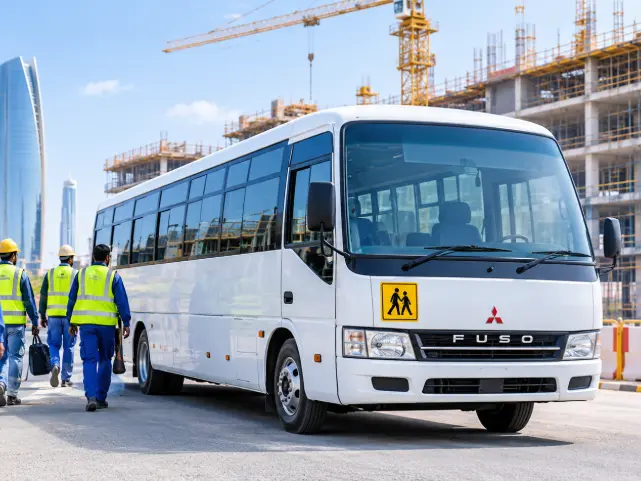
Construction Staff Transport in Abu Dhabi: Route & Shift Planning
Construction staff transport in Abu Dhabi works best when routes and shifts are designed together, not separately. A bus that leaves accommodation at the wrong time or a route that ignores site access rules and summer heat restrictions costs a project productive hours and puts workers at risk. This guide explains how to plan routes, build shift timetables, and stay within the rules that apply to passenger transport in the emirate.
Why does construction staff transport need its own plan?
Office commuting is usually a single morning and evening flow. Construction is different. Headcount rises and falls with each project phase, sites move as new work packages open, and crews often start before sunrise or work split shifts. Workers typically live in shared accommodation that may be in a different part of the emirate from the site, for example in Mussafah while the job is on an island or in a new development area.
That combination means a generic bus timetable rarely fits. Reliable transport directly affects:
- Start-of-shift punctuality: late arrivals delay toolbox talks, permits to work and equipment allocation.
- Worker safety: tired, overheated or rushed workers face higher risk on the road and on site.
- Compliance: passenger bus operations are regulated in Abu Dhabi, and heat protection rules apply every summer.
- Cost control: poorly matched vehicle capacity means paying for empty seats or running overcrowded trips.
What rules apply to staff buses in Abu Dhabi?
Two key regulatory areas influence construction staff transport in Abu Dhabi: passenger transport regulations overseen by the Integrated Transport Centre (ITC), and worker protection requirements established by the Ministry of Human Resources and Emiratisation (MoHRE).
ITC permits, driver approvals and vehicle tracking
The Integrated Transport Centre (ITC), operating under the Department of Municipalities and Transport, regulates passenger bus transport in Abu Dhabi. Under its regulations, a bus is defined as a vehicle with a capacity of more than nine passengers, including the driver, according to the manufacturer’s classification.
Transport operators must obtain the required operation permit, individual bus permits and relevant driver professional permits before providing passenger bus services. The ITC manages these requirements through its Asateel platform, which also supports electronic vehicle tracking. Vehicles must have functioning, approved tracking devices installed to qualify for permits.
For construction companies, the practical step is to verify that their transport provider holds the necessary permits and that its buses and drivers meet the applicable requirements. Companies should also check vehicle registration, insurance, air conditioning and tracking arrangements before finalising a transport contract.
The summer midday break and worker safety
The UAE’s Occupational Heat Stress Prevention Policy, commonly known as the midday break, applies annually from 15 June to 15 September. During this period, outdoor work under direct sunlight is prohibited between 12:30 pm and 3:00 pm.
Employers must follow the applicable heat-stress prevention requirements and provide appropriate worker protection, including shaded rest areas, drinking water and suitable cooling facilities. Certain activities may qualify for exemptions under specific conditions and regulatory requirements.
For construction companies, this restriction is an important consideration when planning staff bus schedules. Pickup times, site transfers and shift arrangements should account for the midday break so workers can travel safely and reach designated rest areas without disrupting site operations.
How to Plan Staff Transport Routes in Abu Dhabi?
Good route planning starts with data you already hold: where each worker lives, which site and gate they report to, and which shift they work. Then build the route in steps.
- Group workers by accommodation and shift: Workers who live in the same camp or building and start at the same time can share a fixed route. Mixing shifts on one bus forces long waiting times at one end of the trip.
- Map the drop-off point to the real site entrance: Many sites have separate gates for personnel, vehicles and deliveries. A bus that drops workers at the wrong gate adds walking time and can create safety conflicts with site traffic.
- Test the route at the real shift hour: Drive the route at the actual departure time, not mid-day, so you see true traffic and any security checkpoints.
- Add buffer time: Build in a margin for loading, headcount checks and site entry procedures so that a small delay does not push the whole crew past start time.
- Plan a fallback: Decide in advance what happens if a bus breaks down: a standby vehicle, a reserve driver, and a clear contact for the site supervisor.
- Review regularly: Re-check routes whenever headcount changes, a camp moves, or a site opens a new gate.
Planning factor | What to decide | Why it matters |
Pickup points | Single camp pickup or several stops | More stops add time but may reduce walking in the heat |
Site gate | Which gate each crew uses | Reduces delays and keeps buses away from heavy site traffic |
Departure time | Set against site start time and entry checks | Protects punctuality without excessive waiting |
Vehicle size | Match seats to crew size per route. | Avoids overcrowding and unused capacity |
Backup vehicle | Standby bus and driver | Keeps the shift on schedule if a vehicle is out of service |
How to Schedule Shifts Around the Midday Break?
During the summer break period, working hours are commonly split into a morning block and an evening block, with the 12:30 pm to 3:00 pm window left free of outdoor work. That has direct consequences for transport, because a single site can generate up to four bus movements a day instead of two.
- Stagger departures: Release crews in waves so buses are not all needed at the same moment.
- Decide where workers rest: If workers rest on site, make sure shaded and cooled rest areas are ready before the break starts. If they return to accommodation, schedule the midday trips and confirm bus capacity for them.
- Keep the evening return flexible: Work often finishes at slightly different times by trade. Plan vehicle availability for a short window rather than a single minute.
- Use a different pattern outside summer: From mid-September to mid-June, a simpler two-trip day may work again. Revisit the whole timetable twice a year.
How to Protect Worker Health During the Commute?
Because the commute is part of a worker’s exposure to heat and fatigue, treat it as part of your health and safety plan, not as a separate logistics task.
- Working air conditioning on every bus, checked as part of daily vehicle inspection.
- Drinking water available on board, particularly in the hotter months.
- No standing passengers and no overloading. Seat each worker and use seat belts where fitted.
- Limit waiting in the sun. Pickup points should be shaded or inside the accommodation compound where possible.
- Avoid excessively long journeys. Fatigue from long commutes affects alertness on site as well as on the road.
- Know the warning signs of heat illness, such as dizziness, headache, nausea, heavy sweating or confusion, and make sure drivers and supervisors know the emergency procedure. In a medical emergency in the UAE, call 998 for an ambulance.
Own Buses vs. Hiring a Transport Contractor: Which Is Better?
Owning a fleet gives direct control but also means managing permits, driver permits, tracking devices, servicing, insurance, spare vehicles and replacement drivers. A transport contractor takes on those tasks and can adjust the number of vehicles as the project moves between phases. For short projects, or projects whose headcount changes often, contracting is usually the more flexible option. For a long, stable programme with consistent routes, some companies prefer to own part of the fleet.
When comparing providers, ask about: ITC permits and driver permits, tracking and reporting, vehicle age and maintenance routine, backup vehicle availability, how quickly routes can be changed, and how incidents are reported.
Planning checklist for construction staff transport
- Headcount by accommodation location and shift
- Site gate and drop-off point confirmed with site management
- Departure times tested at real traffic conditions
- Summer midday break schedule and rest arrangements agreed
- Provider permits, driver permits and vehicle tracking verified
- Daily vehicle checks, air conditioning and drinking water confirmed
- Backup bus and driver arranged
- Single point of contact for delays and incidents
- Review date set for routes and timetable
Reliable Staff Transport for Construction Projects
Reliable construction staff transport in Abu Dhabi depends on more than arranging buses. It requires careful route planning, dependable vehicles, suitable shift schedules and attention to worker safety and transport regulations. Choosing an experienced transport provider can help construction companies coordinate daily workforce movement while keeping site operations organised.
Blue Line Transports, established in 2018 and based in Abu Dhabi, provides labour and staff transportation for construction companies, industrial facilities and other organisations across the UAE. With a fleet of more than 240 vehicles, the company can support different workforce sizes and transport requirements through customised routes and shift-based arrangements.
Whether you need daily transportation between worker accommodation and construction sites or scheduled transfers for multiple shifts, Blue Line Transports can help plan a suitable arrangement around your operational requirements. Contact the team with your workforce size, pickup locations and shift timings to discuss a transport plan for your project.
Frequently asked questions
What is the midday break for construction workers in the UAE?
Outdoor work under direct sunlight is prohibited from 12:30 pm to 3:00 pm each day between 15 June and 15 September under MoHRE’s Occupational Heat Stress Prevention Policy. Employers must also provide shaded rest areas.
Do staff buses in Abu Dhabi need a permit?
Yes. Companies operating passenger bus services must hold an ITC operation permit, register vehicles and drivers through the Asateel platform, and have vehicles connected to an electronic tracking system.
How should construction companies plan staff transport routes?
Group workers by accommodation and shift, map fixed routes to the correct site gate, test departure times in real traffic, add buffer time, arrange a backup vehicle and review routes as headcount changes.
Is it better to own staff buses or use a transport contractor?
A contractor offers flexibility and takes on permits, maintenance and drivers. Owning buses gives more direct control but adds cost and management work. The right choice depends on project length and how much your headcount changes.

Leave A Comment